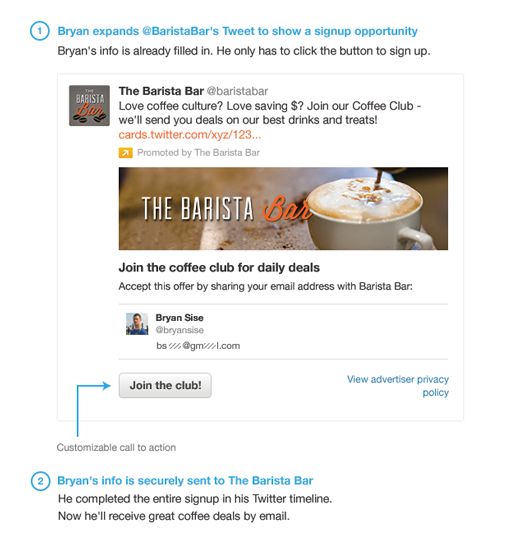
Capture User Interest With the Twitter Lead Generation Card
See full story on twitter.com

See full story on twitter.com
Research shows that social media is using images and graphics even more than past reports. The following infographic show the effects of a visual twitter:
From AllTwitter
Did you know that more than one-third (36 percent) of all links shared on Twitter point to an image, but that as many as three-quarters (77 percent) of tweets that link to an image from a brand do not reference the brand by name?
It’s hard to feel any sympathy for Coca-Cola, but soft drink brands are the least likely to be tagged by Twitter users who share photos of their products, followed by beer, luxury and sport brands.
However, you have to wonder: does that really matter? It certainly might be an issue if you’re a new business where every mention of your brand is essential to your growth, but Coca-Cola, Inc. is the absolute definition of a global marketing terminator. As for why, I’m reminded of Andy Warhol’s famous quote:
“What’s great about this country is that America started the tradition where the richest consumers buy essentially the same things as the poorest. You can be watching TV and see Coca-Cola, and you know that the President drinks Coke, Liz Taylor drinks Coke, and just think, you can drink Coke, too. A Coke is a Coke and no amount of money can get you a better Coke than the one the bum on the corner is drinking. All the Cokes are the same and all the Cokes are good. Liz Taylor knows it, the President knows it, the bum knows it, and you know it.”
So I’m not sure there’s much of a need for Coca-Cola to be tagged by Twitter fans who are sharing images of Coca-Cola products, nor do I think it matters all that much to the brand. But for a mom and pop business it absolutely does matter – visuals are processed up to 60,000 times faster than text, but potential new customers still need to know where to go to buy the products.
Check the infographic below for more detail on why images have become ubiquitous on Twitter.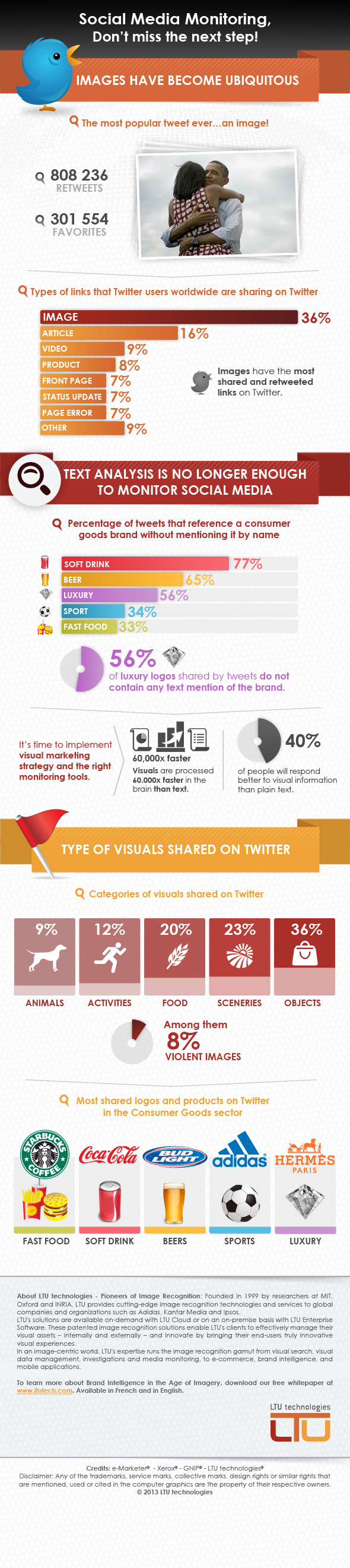
 I read a story about someone getting unfollowed on Twitter and couldn’t believe the fuss about Twitter unfollows.
Asking why someone unfollows you, or even just monitoring it seems like too much effort and not profitable, so for those worried about such things.. I give the following response:
There is way too much fuss over the etiquette of who “should” follow who. I think it comes off like Miss Manners telling people how many phone numbers should be in a address book.
Back in the early days when we were writing “Twitter Revolution: How Social Media and Mobile Marketing are Changing the Way We Do Business” we saw two arguments going.
There’s some logic in any approach one takes.. but it’s their business, not mine.
We ended up starting the book with the two words I still live by — NO RULES — who you follow and unfollow is your business. Who I follow is my business.
I have wasted a lot of time “trimming” my follow account. Above 100k, the most likely criticism is “you look like a spamer if you follow everyone” — I translate this a “YOU CAN’T PLEASE EVERYONE”
I took on the trimming project to see if I could get a more realist view of people. Now at 60k + I can’t see anything different than when it was 90K. Which seems obvious to me. I also can’t tell the difference from when I followed 3000. There’s way more tweets than I’ll ever see, and I read lists and mentions.
Still, I can easily respond to EVERY tweet with my name and probably could with triple the tweets. I have to occasionally filter out #FF tweets and other things with lists.. I’ve never seen the point of posting a list anyway (if I want to know who you think is a super BFF, I’ll just read your profile 🙂
My standard response for #FOLLOWMEBACKORIWILLCRY tweets is “I follow who I want” .. since they talked to me, I’ll probably follow them.. as I follow people who I have conversations with.
Wouldn’t it be nice if we had numbers like “how many people you talk to” and “how many you’ve helped”
Follower counts don’t count.. the only number that matters it ONE.. the one person I’m in conversation with at any moment… the others are just “potential conversations”
Share your thought in the comments.


It’s not enough to just set up a profile and expect wonderful things to start to happen, as if by magic. Twitter, like life, doesn’t work that way. You need to do the work, and you need to put in the hours.
And the good news?
Most of Twitter can be reduced to one basic requirement: show up. And then keep showing up. Be a presence. Let people know that you’re there, that you’re proactive, that you’re listening, that this isn’t a fad or a phase, and that you’re committed for the long run.
Bottom line? Keep putting one foot in front of the other.
Here’s the thing. You don’t have to be on Twitter constantly, obsessing and talking about every little thing. In fact, that’s the worst thing you can do. It’s very much about balance. But that doesn’t mean the opposite is true. In fact, far from it: if you invest nothing into the network I can absolutely guarantee that you are going to get nothing back.
Don’t underestimate the value of being solid and dependable. If I can paraphrase Woody Allen for a moment, I’d say that’s 90% of what it takes to be successful on Twitter.
See full story on mediabistro.com
Do you need a Twitter Cheat Sheet?
There are a many myths about engagement. Rules made up at cocktail parties and measurements that don’t allow for the one to one human connection that Twitter does best.
Dashburst reviewed a new Twitter Cheat Sheet. The facts are right, but before you implement them, let’s have a discussion here about how following them can hurt you

Are you getting the type of interaction and retweets you always hoped for on Twitter? Did you know you could basically double your engagement rates on Twitter just by including an image within your tweet? Or that using more than two hashtags or tweeting too much can significantly lower your interaction rates? Twitter is the fastest growing social network increasing by 40% over the last half of 2012. This makes it paramount for your business to master the intricacies of Twitter, which will help further raise awareness about your and and generate additional new leads.
So here are some great tips and tricks to help you increase engagement on Twitter like follower retweets, click-through rates (CTR) and replies.
First off, 78% of the engagement with a and is through retweets. As the number of tweets you send per day increases though, engagement will typically decrease. The other 22% of engagement with a brand’s tweets are from replies.
92% of the interaction with a brand’s tweets are by clicking links, but most businesses don’t realize that the engagement rates for brands are 17% higher on Saturday and Sunday–only 19% of brands actually tweet during the weekend. Brands typically see 30% higher interaction rates tweeting from 8am to 7pm. Tweets that contain less than 100 characters also receive 17% higher engagement than longer tweets. So keep it short and sweet! Tweets that contain links receive 86% higher retweet rates than tweets without links. The bottom line is people are looking for you to provide them with links to relevant information.
Tweets with hashtags recieve 2X more engagement than those without hashtags, yet only 24% of measured tweets contain hashtags. Tweets with one or two hashtags have a 21% higher engagement than those with three or more hashtags. However, tweets that use more than two hashtags actually show a 17% drop in engagement. So using hashtags can be effective, just don’t overdo it!
Tweets with image links have twice the engagement rates compared to tweets without images! Also, tweets that ask followers to “Retweet” recieve 12X higher retweet rates than those that do not. However, only less than 1% of ands implement this strategy. In fact, when followers are explicitly asked to and “Retweet” is spelled out, the retweet rate is 23X higher than the average. When using the shortened term “RT” instead, the retweet rate is only 10X higher.
See full story on dashburst.com

#HashTag
Hashtags (the letters and symbols that work ad a code staring with a pound sign “#”) have been on Twitter since nearly the start
While they are known for adding silly fun or searchiness to a tweet, that aspect has never been needed. Search can find ANY word in a tweet.
I’ve always liked them for events. Affiliate Summit, the big show this week in Vegas, could be in a tweet about the event, but sometimes doesn’t fit in the sentence. So without explaining where the tweet comes from, users add #ASW12 and everyone at the event, or following it can easily see what happening in real time.
Twitter didn’t invent hash tags. It’s a hack like comments in software code that was added by users. Over the years, Twitter had made them clickable, and many use them for all sorts of things.
Now Twitter is working on EVENTS.. which will eliminate this necessity
At Twitter, that means associating a tweet with an event, tied to it by a number of keywords. That may mean that the keywords auto-associate to the event itself.
“I think we’re finally going to have the Events feature,” Stone said, in a brief interview. “It’s something we’ve been talking about forever… and now that Ev’s back on products, I think that’s something that’s going to be coming up soon.
“Obviously Twitter electrifies events. You’re connected to it, in this matrix,” Stone added. “You want to be connected to it, if you’re there; but if you’re not there, you don’t want to hear about it… And in a short time, it’s gone.”
My guess would be that hashtags are going to be around long after EVENTS and other features are added.
What’s your favorite tag?